Showing posts with label Stereographic. Show all posts

Wednesday, 4 June 2014

Great Caldera Poster Map Finished

Close to a year of work on the Great Caldera's overview map came to a head last weekend, and the map is finally complete, and entering the pre-print stage.

Vicinity of Seahollow, capital city of the fellfolk nation of Belledor, Great Caldera, World of Calidar.  Topographical map.  Stereographic Projection.
The area around Belledor's capital.
Exciting times for me, as this will be the first map I've ever had printed.  

Meanwhile, Bruce has posted two articles previewing the maps.  Part one covers the southern realms of the Great Caldera, while part two deals with the northern half.   He mostly concentrates on giving some background to the labels he devised for each nation.  It's a great read, with some tantalising hints of what is to come, as well as some classic Heardian humour.

I'd like to add a few comments about the creation of the art featured on these maps.

First up is the Belledor fragment at the top right, which depicts the area around Belledor's capital, Seahollow, in the province of Seafolk.

Grimsvik is the capital city of Nordheim, and also regional capital of Steinfold, Nordheim's leading realm, in the Great Caldera, World of Calidar.  Topographical map.  Stereographic Projection.
Grimsvik, capital of Nordheim.
The map is composed of numerous layers, which all come together to produce the terrain you see here.  At the base of everything is the height map, which I have posted about extensively already.  Suffice it to say that this map took about six months to design and erode at full resolution.  It is a 3D model, with sculpted mountains and valleys, rolling hills, and rivers meandering through the plains.  On top of this is a gradient map, colouring the terrain based on elevation, so that the plains and lowlands are light green, the hills are tan, and the mountains are grey-brown.  There are actually five or six of these gradient maps, allowing the painting of other terrain types such as grasslands, desert, swamp, and taiga on top of the plains.

What this means is that you can tell the elevation of any particular spot just by looking at the colours, and on the height model I can measure the exact height of any point on the map if necessary.  Mountains named on the larger scale maps (such as the hex map) refer to actual peaks visible on this map.

Central area of wizarding realm Caldwen, including its capital, Arcanial, in the Great Caldera, World of Calidar.  Topographical map.  Stereographic Projection.
Central Caldwen.
Next come the sea and lake masks, and the rivers.  The sea is a simple mask derived from the base height map, coloured blue.  The rivers are also generated from the height map.  We decided on the general locations during the design process, and then let erosion create the exact shapes in a natural way.  For some areas — Alfdaín comes to mind — this took multiple attempts, and was a bit of a headache, but I'm very pleased with the final results.  Lakes were added to the height map after erosion; Bruce designed logical shapes that fit in with the river systems, and I dug them into the height map.

At this point, we haven't done any work on lake or sea beds.  That may come at some point in the future, but for now it's all just flat surfaces.

With the land and sea all done, the last three layer groups add lighting, texture, and overlays.  Lighting consists of a 3D render of the height model, which with transparency effects gives shape to the underlying terrain.  Texture is predominantly visible in the sea areas, and to a lesser extent on the land.  It is a parchment texture, designed to bring consistency to the map.  I chose not to also incorporate the colour of the parchment this time.

Mythuín, in the Matriarchy of Andolien, is the capital of the elven realm of Alfdaín, Great Caldera, World of Calidar.  Topographical map.  Stereographic Projection.
Alfdaín's capital, Mythuín.
Finally overlays refers to the graticule (the grid of latitude and longitude lines over the map), borders, roads, icons, scale, legend, and of course all the labels.  This layer sits on top of everything else.

I will post more about all of these things after the release.

For now, I am now putting all my efforts into the second poster map, the hex map of Meryath, which is also mostly done.  The finishing touches should be done by the end of the week.  After that, it's back to the internal maps.  These, too, are at an advanced stage of design.  Everything should come together within the next few weeks.  It will not be long now before you can hold the book and the maps in your hands.

A full view of the dwarven realm of Araldûr, Great Caldera, World of Calidar.  Topographical map.  Stereographic Projection.
Araldûr, home of the dwarves on Calidar.  This image shows almost exactly what the final map will look like.

Wednesday, 18 December 2013

A Study in Scale: Meryath

My article on scale was perhaps lacking in clear examples, so I have prepared some more images to show visually what I described in that article.

To recap, I have been developing the +World of Calidar on three different scales:

• World Map, 2 km/pixel
• Continental, 0.5 km/pixel
• Local, 0.125 km/pixel

The step down between each scale is a quadrupling of the previous one.  So a single 100 x 100 pixel area of the world map would become a 400 x 400 pixel continental map, or a 1,600 x 1,600 pixel local map.  It's important to understand that these scales all show the same area.

Kingdom of Meryath, Calidar, Eroded Height Map Scale Comparison, Albers Equal Area, Stereographic Projections
Kingdom of Meryath Scale Comparison
Here's what this looks like for Meryath.  Note that the full resolution local map is far too big to display at full size here, so I have scaled all the maps down to fit.  They are still in scale with each other, regardless of what size they are viewed at.

The point to take away from this is perhaps rather obvious, but its implications are not.  Clearly, higher resolutions show more detail.  Moreover, erosion produces more realistic results at higher resolutions/larger scales.  What's perhaps not so clear, but crucially important for cartography, is that the smaller scales are not meant to show things in great detail.

What this means is that even though the local scale map is much more detailed, it doesn't mean that it's better than the other maps.  Although it could be used to make the other two maps more detailed, you have to ask yourself if that's necessary – or even desirable.  Will it actually show more detail when reduced down so drastically?  There's a real possibility that it will in fact do the opposite, obscuring the important details with a mess of barely visible tiny details.

This is the crux, which I forgot to state clearly in my article on scale: world maps need only show world level detail.  Continental maps need only show continental detail.  Local maps are where you can go all-out on fine detail, but even then, if you feel like you're crowding things in, perhaps it's time to move down to another, larger scale still.

Finally, here are the three images in the scale comparison all scaled to the same size.  The local map has been shrunk down to less than a quarter its full size; the continental map is just a little smaller than full size; and the world map has been almost quadrupled from its native (rather tiny) size.  Bearing in mind the purpose of each scale, it's interesting to compare the difference in detail shown on each map.

Kingdom of Meryath, Calidar, Eroded Height Map Local Scale, Albers Equal Area Projection Kingdom of Meryath, Calidar, Eroded Height Map Continental Scale, Stereographic Projection Kingdom of Meryath, Calidar, Eroded Height Map World Map Scale, Stereographic Projection
Local Scale Continental Scale World Map Scale

Thursday, 12 December 2013

Calidar Kickstarter Has Begun!

+Bruce Heard just hit the big green button, signalling the start of the Kickstarter.


This is it, folks.  This is what we've been working so hard over the past six or seven months to bring to you.  You can make it possible.

But let's not stop there: let's make it a massive success!  I want to still be reading new Calidar stories from Bruce ten years from now.

Vote with your feet, and opt in to the World of Calidar now.  We're counting on you.

Here's a freebie for you to enjoy - my latest test map of the Great Caldera.  You can see it on the Kickstarter page, too.  The final format has yet to be decided, but these one of the possibilities for the Great Caldera poster map.

The Great Caldera, Calidar, Topographic Map, Stereographic Projection
The Great Caldera Topographic Map, Stereographic Projection
And here's a crop at 2/3 resolution...

Close-up of Araldûr from The Great Caldera, Calidar, Topographic Map, Stereographic Projection
Close-up of Araldûr from the map above
 The full size file has so much detail.  It's going to be a gorgeous poster map.

Close-up of Meryath from the map above
Thanks for supporting Calidar!

Monday, 9 December 2013

Thorf's World-building Techniques: Introduction

Thorf's World-building Techniques: The Making of the World of Calidar
The Making of the World of Calidar
by Thorfinn Tait

For the past six months or so, I have been working on +Bruce Heard’s new project, the +World of Calidar.  Bruce brought me on board early on, first in an advisory role, then as Calidar’s official cartographer.  Working with Bruce is tremendous fun – in fact it’s nothing less than a dream come true, really.

Hex Map of Karameikos, 8 miles per hex, Mystara
Mystara Hex Map of Karameikos
Atlas of MystaraYou see, I grew up on the Known World and Mystara, and I was an avid reader of Bruce’s Voyages of the Princess Ark articles in Dragon magazine – not just the stories, but the specific combination of fiction with gazetteer info, and the all-important hex map that accompanied it.  Inspired by Mystara’s maps, I went on to create my own system for hex mapping, using Adobe Illustrator, and I have since recreated and updated almost all of Mystara’s published maps.  It’s through my Mystara Atlas project that I learned most of my cartographic skills and knowledge.


Hex Map of Bruce Heard's Alphatia: Floating Ar, 8 miles per hex, Mystara
Remake of Bruce's Floating Ar Hex Map
The Mystara community is friendly, civil, and just generally pretty wonderful, but the setting has been out of print for almost twenty years now.  For years, I have longed to work on a living and breathing setting.  With Bruce’s return to the industry last year, for a while it seemed like this may indeed come to pass, as he produced new articles and maps detailing Mystara’s continent of Alphatia.  However, the current rights-holders turned down Bruce’s licensing proposals, and the possibility faded.


Calidar: In Stranger SkiesHowever, in its place, like a phoenix rising from the ashes, the World of Calidar project was born.  For a Mystara fan, Bruce’s announcement was a bittersweet moment, but since then there has been no looking back.  I think it’s no secret that I am a huge fan of Calidar already.


So, getting back to the topic at hand, Bruce started sharing drafts of Calidar’s world map with me back in May.  Then in July, he tasked me with making maps of Calidar.  Since then, I have been working on all aspects of Calidar’s geography, in close collaboration with Bruce.


The World of Calidar, World Map, Equirectangular Projection
Calidar World Map, Equirectangular Projection
Climate Shading Test of the Great Caldera, Calidar
Great Caldera Climate-Shading Test
Mapping out the new World of Calidar has meant building a fantasy world from the ground up – or perhaps rather from space down.  Starting with the world map, then zooming in on one major continent, and finally zooming in one step further to deal with individual countries in that region, this project demands a number of different styles at various scales.  I’m most well-known for my hex maps, and while Calidar will of course have its own hex maps, these will be just one of a number of mapping styles – I have been expanding my cartographer’s toolkit greatly for this project.


Render of the World of Calidar with one of its moons, Kragdûr
Calidar with Kragdûr, one of its moons
I will be documenting all of these techniques in this series of making of tutorial articles.  I hope that the “making of” parts will be of interest to Calidar fans in general, while the tutorial parts should be of use to my fellow fantasy cartographers, from whom I have learned a great deal during my work on this project.


Planned sections include:
  • Continental Outlines
  • Base Height Field
  • Erosion
  • Climate Shading
  • Planetary Models
  • World Maps
  • Continental Maps
  • Hex Maps
The order may change, depending on which sections become ready for posting first.

Click here for the series index.

Wednesday, 4 December 2013

Map of the Day 15: Omfall

Calidar's western hemisphere is home to two great continents.  Last week we explored Eerien.  Today our world tour brings us to Omfall.

Stretching from 22ºN all the way down to 67ºS, Omfall is a massive continent encompassing a large variety of terrain types.  Omfall pushes right up against Eerien to the north, with but a narrow channel running between them.  This channel is known as the Aesean Duct.  The tropical Mareas Island is in the northeast of this map, between separating Omfall from the Great Caldera.  Below that is the Taslan Peninsula.  From both Mareas and Taslan run strings of islands which connect up with the Arm of Ule, separating the Calderan Sea from the great Penggelan Ocean along Omfall's eastern coast.

Omfall, Calidar, Stereographic Projection

In the far south, the Cape of the Last Howls points south towards Mormoroth, touching the Antarctic Circle.

I am currently working to finalise Omfall's height map for the erosion process.  In Omfall's case, because it's so huge, erosion will likely take about a week.  It's important to get the terrain right before starting erosion, because fixing problems is much harder after erosion.  If we need to revise the map, it generally means going back to the pre-erosion map, then running it through erosion once again, which takes up a lot of time.

Omfall mountain design, Calidar, Stereographic Projection
Omfall Mountain Design
Stereographic Projection
As with previous maps, Omfall's height map was built from +Bruce's mountain design.  The thick brown lines represent major mountain ranges, while the thinner red lines are more minor ranges.


Take a look at how the design evolves.  The first draft quite faithfully follows the mountain design.

Omfall uneroded height map, Calidar, Stereographic Projection
First Draft
The mountain ranges are too regular, don't you think?  They needed messing up a bit.  This was done in the second draft.

Omfall uneroded height map, Calidar, Stereographic Projection
Second Draft
You can also see some notes from Bruce marked up in the second draft.  These were areas to lower.  The third draft incorporates these changes.

Omfall uneroded height map, Calidar, Stereographic Projection
Third Draft
The fourth draft, which I am working on now, includes the all-important altitude scaling of the mountains which I mentioned previously for Eerien.  Without this scaling, all of the mountains throughout the continent will end up being roughly the same height.

There are two more islands to look at to round out the western hemisphere.  Come back again tomorrow for a look at the first of these.

Friday, 29 November 2013

Maps of the Day 4-8: Building the Mountains of the Great Caldera

After the coastlines, the mountains are probably the second most distinctive feature of most fantasy worlds.  Let's take a look at the development of the Great Caldera's mountains.
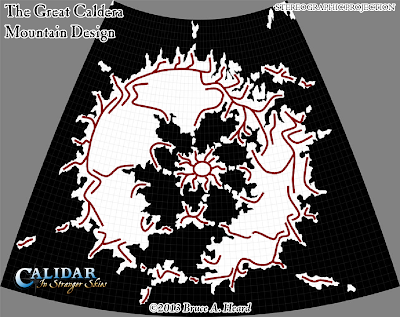

Great Caldera, Calidar, mountain design, Stereographic Projection
The Great Caldera Mountain Design, Stereographic Projection
The first image is +Bruce's design for the mountains of the Great Caldera, painted onto the Stereographic Projection from last time.  You can see how the mountain ranges generally follow the outside of the circle, forming a gigantic rim around the ancient impact crater.  Time has worn it down, and it is broken in a number of places.

Bruce drew these lines as guides for constructing a full height map (also known as a bump map, elevation map, or digital elevation model) of the area.  I took the lines, blurred them, messed them up a bit, and converted them into uneroded mountains.

Next, I took the same lines and expanded them out, then messing them up in a similar way to create hills.  
The second image is the resulting fully-detailed height map.
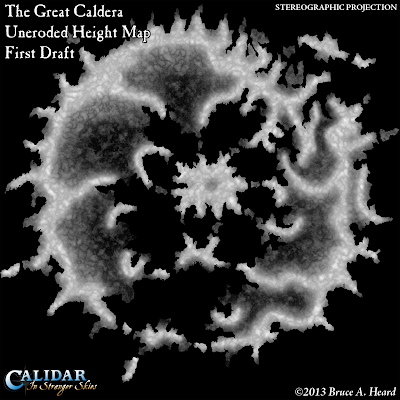

Great Caldera, Calidar, uneroded height map, Stereographic Projection
The Great Caldera Uneroded Height Map (First Draft)
Stereographic Projection
A word about height maps: this map shows elevations, with black being the lowest point – in this case, sea level – and white being the highest.  It takes some imagination to understand what's going on, but basically speaking the white points are mountain peaks, while the grey lines in between them are valleys, and the darker grey to almost black areas are hills and plains.

You may be wondering why such a map is necessary or even desirable.  The answer is that this map can be loaded into terrain viewer programs, which show it as a 3D model of the terrain.  Many computer games use these models to construct their worlds, and just as in those games, it's possible to move around and explore the landscape.
Height maps form the basis of all of Calidar's maps, and they open up exciting new possibilities for Calidar's cartography and art.  Their altitude data can be used in conjunction with latitude to calculate a simulated climate model, which in turn can even be used to texture the world according to each area's biome.  All of this is made possible by the height map, which is why I have spent more than four months so far building, eroding and refining Calidar's geography.

Great Caldera, Calidar, uneroded shaded height map, Stereographic Projection
The Great Caldera Uneroded Height Map (First Draft - Shaded)
Stereographic Projection
The third map, on the left, is exactly the same map, but instead of displaying low-to-high elevations as black-to-white, it uses a colour scheme to shade each height, making it a little easier to visualise what exactly is being depicted, but you have to bear in mind that the colours represent height variations, not terrain types.

Blue is sea level, light green-to-darker green is lowlands, light brown-to-dark brown is progressively higher areas, and dark brown-to-white is highlands.

Generally speaking, the lowlands are flatter than higher areas, so it's relatively safe to assume that green areas are lowland plains, or at most rolling hills.  But there could also be some lonely mountains in the green areas, too.

Now, you probably noticed that this height map (in both colour palettes) is labelled as being "uneroded".  That is to say, it has not undergone simulated erosion to carve mountains and valleys into those mounds.  This is a multi-stage process which takes anything from a few hours to a few days, depending on the size of the area and the resolution it needs to be done at.  This model is roughly 0.5 km per pixel at full resolution, and the full image is 9,999 x 9,998 pixels.  This provides a good level of detail for continental mapping, though perhaps not enough for country-level maps.

The fully eroded version of this map is the Great Caldera map with borders and labels which Bruce revealed in the initial announcement of the +World of Calidar, which you can see below.


Great Caldera, Calidar, eroded height map, Stereographic Projection
The Great Caldera Eroded Height Map (First Draft - Shaded), Stereographic Projection
Here it is: the first completed draft of the Great Caldera's fully eroded height map.  Compare it with yesterday's pre-erosion map, and you can plainly see how the white blobs have been carved into majestic white peaks.  What was previously a landscape of blobs has become a proper landscape of plains, hills, mountains and valleys.  A lot of land has disappeared during the erosion process, carried down to the lowlands and into the sea by simulated rain and water courses, which is why everything looks so much lower.

Taking a look at the geography of the Great Caldera, at this point it becomes very clear why its borders are located where they are: the political divisions follow natural divisions in the terrain, which split the land of the Caldera into numerous smaller areas.

Note that this is the first draft; there are various problems with this map, and in fact there have been another three passes since this map was completed.  I'm quite happy with the fourth draft, so it may well become the final one.

I'm sure many will be impressed with this, but I'm equally sure that some may be thinking: so what?  Why is this useful?  Why don't you stop talking about things and just show us the finished maps?

Don't worry, we'll get to some major reveals very soon.

In the meantime, here are some 3D views of the terrain for your enjoyment.
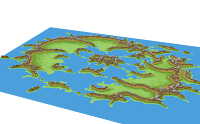
Great Caldera, Calidar, 3D views of eroded height map, Stereographic Projection
Great Caldera, Calidar, 3D view of eroded height map, Stereographic ProjectionThese very simple 3D views of the Great Caldera demonstrate the huge benefit of height maps, which is to say that they are really 3D models.  Using these very same height maps, it is possible to generate photorealistic-looking landscape views.
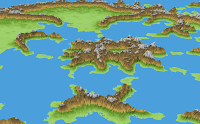
Great Caldera, Calidar, 3D view of eroded height map, Stereographic Projection
Great Caldera, Calidar, 3D view of eroded height map, Stereographic ProjectionBut for now, this is not our goal; the first priority is of course to establish the terrain and its shapes by producing high quality maps of the area.  The height maps help in this, too – not only by allowing the correlation of altitude and latitude data for climate shading, but also in generating river maps; in providing shaded relief for political maps; in guiding the creation of hex maps; and other ways besides.  I hope you can see why I have chosen to develop Calidar's terrain in this way.

The shading you see here is the same simple, elevation-based shading as on the colour maps above.  Note how the flat map's colours have been adopted into the 3D view.  It's actually possible to load any image as a texture for the 3D model, so even without photorealistic rendering, you can expect to see more of these 3D views – and prettier ones, too.

More about all of this later.  This brings us to the end of our first week of Maps of the Day, exploring the Great Caldera, the heart of the World of Calidar.  Thanks for reading!  Join us again next week as we preview the shape of the Dread Lands which lie outside the relative safe haven of the Great Caldera.

Thursday, 28 November 2013

Maps of the Day 1-3: Mapping the Great Caldera

Welcome to the Calidar Map of the Day series!  In this series of posts, I will be sharing a pre-production or work-in-progress map every day to preview my work on +Bruce Heard's upcoming setting, the +World of Calidar, which I am involved in as cartographer.


Great Caldera, Calidar, Equirectangular Projection
The Great Caldera, Equirectangular Projection
Our journey through Calidar begins with the Great Caldera – the heart of the setting, and the most settled region on the planet.

The result of a massive collision in Calidar's ancient history, the Great Caldera is a perfect circle with a mountainous rim.  This presents a unique mapping challenge: drawing a circle on a sphere is easy, but the rectangular map projections usually used to design worlds are another matter entirely.

The 2:1 latitude/longitude grid known as Equirectangular, Plate Carrée, or simply Geographic Projection is very useful because it is easily applied to 3D spherical models, such as Google Earth.  But the further north or south you go, the more stretched it becomes, until the entire top and bottom lines of the map represent the single points of the poles.

The Great Caldera stretches from 25º to 65ºN, putting the northern part of the Caldera in an area which is very susceptible to these distortions.

Look closely at the first map.  Does it look like a perfect circle to you?  Probably not.  But in fact it is a perfect circle when viewed on a globe.


Great Caldera, Calidar, Stereographic Projection
The Great Caldera, Stereographic Projection
This companion map shows the exact same coastal outlines as the first map, but using a more suitable projection for a circular area.

The Stereographic Projection is particularly appropriate for the Great Caldera, because it shows any circle on the globe as a circle on the map.

If we had just drawn a circle on the Equirectangular Projection base map, it would have ended up being deformed when viewed on a globe.  These days, when it's very easy to set up Google Earth or a number of other programs to display interactive globes in the computer, it was a design priority to get these projection issues right from the start.

Getting back to the map, you can see how the perfect circle of the Great Caldera has collapsed and decayed at various points.  We'll take a look at the design phase for the mountains encircling the Caldera in the next post.


Great Caldera, Calidar, wrong version, Equirectangular and Stereographic Projections
The Great Caldera (Uncorrected Version), Equirectangular and Stereographic Projections
The first two maps showed the final, corrected version of the Great Caldera.  It only looks circular in the Stereographic Projection, of course, but place the Equirectangular Projection on Google Earth and it will become circular again.

This last map predates the first two, showing the same design for the Great Caldera, this time as a political map showing borders and country names.  The inset shows Bruce's original design, which we did on an Equirectangular Projection (as many mappers do, since it allows the aforementioned use of Google Earth).  It looks fine – a perfect circle.  The problem with this is that when it is applied to a globe or other 3D spherical model, the Caldera's shape is deformed, appearing more like it looks in the Stereographic Projection.

So the first two maps above are the result of a proper implementation of this design, as Bruce originally intended it to look.  One last map to illustrate my point: this rendering of the globe of Calidar was made using an Equirectangular Projection world map.  Note how the Great Caldera looks nice and circular, as it is supposed to.
Calidar, Great Caldera, Mareas, Ule, Taslan, Eerien, Laëril, Equirectangular Projection, render of globe
The World of Calidar, Orthographic Projection (also known as "View from Space")
We will continue to look at the effect map projections have on the shapes of Calidar's landforms over the next few weeks.  But before that, let's delve a little deeper into the terrain design, starting with the mountains, and then moving on to height maps.