Showing posts with label Lambert Conformal Conic. Show all posts

Thursday, 5 December 2013

Maps of the Day 10-13: Eerien

To the west of the Great Caldera lies the vast continent of Eerien.
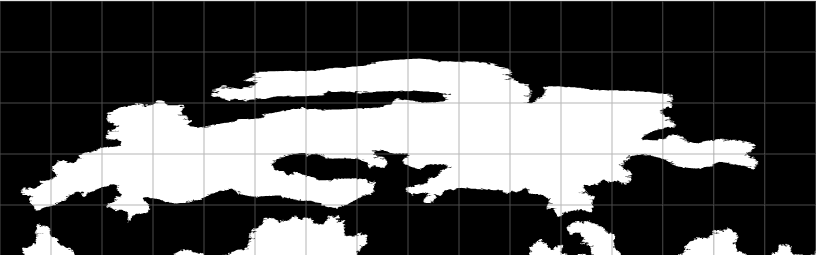
Eerien, Calidar, Equirectangular and Lambert Conformal Conic Projections
Eerien, Equirectangular and Lambert Conformal Conic Projections
The top map is an extract from the world map, showing a little more than a quarter of the map, from the Great Caldera in the east to the Isle of Obb in the west, and from Feorad Island in the north, down to Omfall straddling the equator.  From north to south this area is 10,800 km (6,750 miles), and along the equator it's a little over 25,800 km (16,125 miles).  The top line of the map is of course a single point, being the north pole.

Points of interest include a warped view of Feorad Island (compare it with the Lambert Conformal Conic views in the Feorad article to see what a huge difference the projection makes); the positioning of the Great Caldera in regard to the surrounding terrain; the northern part of Omfall, another huge continent which stretches down to the Antarctic Circle; the Aesean Duct, a narrow sea passage bisecting the two great continents; and of course Eerien herself.

Eerien is home to Calidar's tallest mountains, its highest peak reaching a towering 8,925 m (29,281 feet).  As such, the mountain design is of great importance.

The bottom image shows the true shape of Eerien, projected onto a shape-preserving Lambert Conformal Conic Projection.

The next images show the progression of Eerien's pre-erosion height map design.  This is currently the most developed area outside of the Great Caldera, although other parts of the world are slowly catching up.
Eerien height maps and 3D views, Calidar, Lambert Conformal Conic Projections
Eerien, Lambert Conformal Conic Projection
The top and bottom images are 3D views of Eerien, looking north from a point high above Omfall.  Although they are 3D views, the curvature of the world is not shown, though 3D view of Eerien on the surface of the globe is in the works for a later date.

The top image is a preview of the design, straight from Photoshop.  If you look closely, you should be able to make out that the mountains are all roughly the same height throughout the map - legions of white peaks everywhere.  Eerien is supposed to be extremely mountainous, but we wanted to introduce some variation to the heights.  Considering the sheer size of the base map – a staggering 22,737 × 14,049 pixels – it's not that easy a thing to fix.

However, I came up with an idea, which you can see in the middle image.  It's an adjustment mask which I applied to the base map.  There is a single pure white spot, which remains at full height.  All the rest are increasingly darker shades of grey, which pushed down the height of the mountain peaks under them.  This was all painted manually, and finally blurred before being applied to the height map.

The bottom image shows the result.  At first glance you may be wondering what the big deal is, but look closely and you should be able to see quite a lot of variation has been introduced into the mountain ranges.

One last point: did you notice all the pillars scattered across the bottom image?  These are there for a specific purpose, and of course are only there as temporary markers.  Would you like to hazard a guess as to what they are marking?  Hint: there are lots of them due to the sheer size of the map.

The answer is that they are scale markers, to help keep all the altitudes in sync.  There are lots of them because the map is split up into smaller parts for erosion, and each part must have a marker on it.  The height of the markers is 8,925 m, and on the height map they are pure white, marking the top of the world.

Without these markers, the programs which handle the height maps would make the highest height on each map white, and scale the rest accordingly.  That would mean mountains of 8,925 m all over the world!

he next image shows two renditions of the same height map.  I'm sure you'll agree that the colour version is much easier to read, but unfortunately when I need to make manual changes to the map, I generally have to work on the black and white version.  It's tricky, to say the least.

Eerien, Calidar, height maps, Lambert Conformal Conic Projection
Eerien Eroded Height Map, Lambert Conformal Conic Projection
This is the second draft of Eerien.  In order to perform erosion on this massive continent, I had to split it up into six different sections, each up to 9,999 x 9,999 pixels.  Of course the sections had to overlap, or putting them together would have been very difficult, since rivers would run in completely different courses.

Eerien's erosion has resulted in some very interesting terrain.  My favourite part is the plateau, which has gained a Grand Canyon-like ravine.  Immediately north of the plateau are the highest mountains in the world, so it's a fascinating area all round.
Eerien, Calidar, 3D views of eroded terrain, Lambert Conformal Conic Projection
3D Views of Eerien, Lambert Conformal Conic Projection
In this last image, we present five different 3D views of Eerien's terrain.


At the top you can see the continent in its entirety.


The middle row shows two different perspectives on Calidar's version of the Himalaya Mountains and the Tibetan Plateau.  These are the highest mountains in the world, although it may be difficult to see that at these distances.

The plateau itself is not entirely flat, with its most predominant feature being the massive ravine which snakes its way through.  Presumably all the runoff from the mountains to the north has carved this huge scar into the plateau over many aeons.

Finally there is a closer look at the lowlands to the north of the great mountains, and then a look at the imposing mountains themselves from nearby.

That's it for Eerien for now.  As the Kickstarter start date approaches, we will continue to reveal the World of Calidar.


Saturday, 30 November 2013

Map of the Day 9: Feorad Isle

Welcome to week two of Map of the Day–the Calidar World Tour!
Feorad Isle, Calidar's northernmost land, Lambert Conformal Conic Projection
Feorad Isle – Calidar's northernmost land, Lambert Conformal Conic Projection

Feorad Isle, Calidar's northernmost land, Equirectangular Projection
Feorad Isle, First Draft
Equirectangular Projection
Feorad Isle, Calidar's northernmost land, Lambert Conformal Conic Projection
Feorad Isle, First Draft
Lambert Conformal Conic Projection
We begin our world tour this week with a look at the top of the world–the north pole.  There is no land at the pole itself, but there's an island close to it, which is known as Feorad Isle.  It's likely a cold, mostly frozen land, the vast majority of which lies firmly within the Arctic Circle – which on Calidar lies at 66.5ºN.

Continuing last week's discussion of projection problems, the north and south polar areas of any world pose a particularly thorny problem for world builders working with a rectangular base map, such as the Equirectangular Projection.  The problem is that areas north of 60ºN and south of 60ºS are stretched progressively more and more, until the single point of a pole is represented by the whole top or bottom edge of the map.

Feorad Isle, Calidar's northernmost land, Lambert Conformal Conic Projection
Feorad Isle, Second Draft
Lambert Conformal Conic Projection
Draw landforms in the normal way, and they will invariably end up spiky and squashed-looking.  You can see this in the first draft images on the left.  The solution is to reproject the map to a more suitable projection, and design the area using that projection.  Later, this can be projected back to Equirectangular and added back in to the base map – where of course it will now look stretched, but that's as it should be on that projection.

Feorad Isle, Calidar's northernmost land, Equirectangular Projection
Feorad Isle, Second Draft
Equirectangular Projection
The second draft black and white images show the fixed coastlines, first edited on a Lambert Conformal Conic Projection, then reprojected back to the base Equirectangular Projection.

It's important to consider projections when designing terrain, too, because otherwise the terrain will end up just as warped as the coastlines here were.  This is why each of Calidar's continents has been designed using a projection chosen for that continent.  The Great Caldera is circular, and away from the equator, so it uses the Stereographic Projection.  Feorad Isle is close to the north pole, and so could use Polar Stereographic, but the other side of the pole is uninteresting, with no land, so instead I chose the Lambert Conformal Conic, whose shape is very efficient in this case.


Feorad Isle, Calidar's northernmost land, mountain design, Lambert Conformal Conic Projection
Mountain Design
Lambert Conformal Conic Projection
Looking at these images again, I wonder if perhaps I have gone a little too far in reducing the spikiness of the terrain.  What do you think?  Please let me know in the comments.

After the coastlines have been fixed, it's time to build a height map, working from +Bruce Heard's mountain design.  In this case, the design was squished by the projection change, so it required quite a bit of tweaking; working in an appropriate projection is important not just for coastlines, but also for terrain design.  Even a long mountain range painted onto the Equirectangular projection maps above will be squashed down to a much shorter one when reprojected into Lambert Conformal Conic – or onto a globe.


Feorad Isle, Calidar, satellite view, pre-erosion terrain design, Lambert Conformal Conic Projection
Pre-erosion terrain design–satellite
Feorad Isle, Calidar 3D view, pre-erosion terrain design, Lambert Conformal Conic Projection
Pre-erosion terrain design–3D view


Once the base height map has been designed, it's time for simulated erosion.  In the 3D views here you can see the map in its initial design stage, then in its finished stage.  Note the very distinctive valleys carved into the land, and also how the blobby orange hills turn into sculpted peaks.


Feorad Isle, Calidar, satellite view, post-erosion terrain design, Lambert Conformal Conic Projection
Post-erosion terrain design–satellite
Feorad Isle, Calidar 3D view, post-erosion terrain design, Lambert Conformal Conic Projection
Post-erosion terrain design–3D view


As with the black and white coastline maps, the finished height maps are reprojected into Equirectangular form and added to the world map.  In this way, the world map is slowly taking form. Once its complete, we'll be able to produce accurate maps of any section of the world in whatever projection is needed.


Next time on our world tour, we will journey southwards to one of Calidar's biggest continents of all.